Security & Sensors · Hardware
Smart Door Control & Access
RFID + remote + web-based authorization.
Overview
The problem. Doors in factories and campuses are scattered: outer barriers, warehouse doors, cold rooms, passages between production areas. With wired access control panels, every door needs reader, lock, contact and exit-button cabling; distance and inter-zone runs drive up the cost. Existing plants often have no cable route at all. Remote-type RF door openers, on the other hand, do not record who opened the door, can be copied and do not talk to a central unit. During a fire, nobody knows the state of the doors.
In the field today. The current generation makes the control part of the door chain wireless: door status is monitored and doors are opened and closed from the central touch panel; battery-powered button transmitters at remote points such as the guard booth or on forklifts send open commands to the door receiver over 433 MHz. The door receiver has relay outputs; frequency, channel and output power are set from its LCD menu.
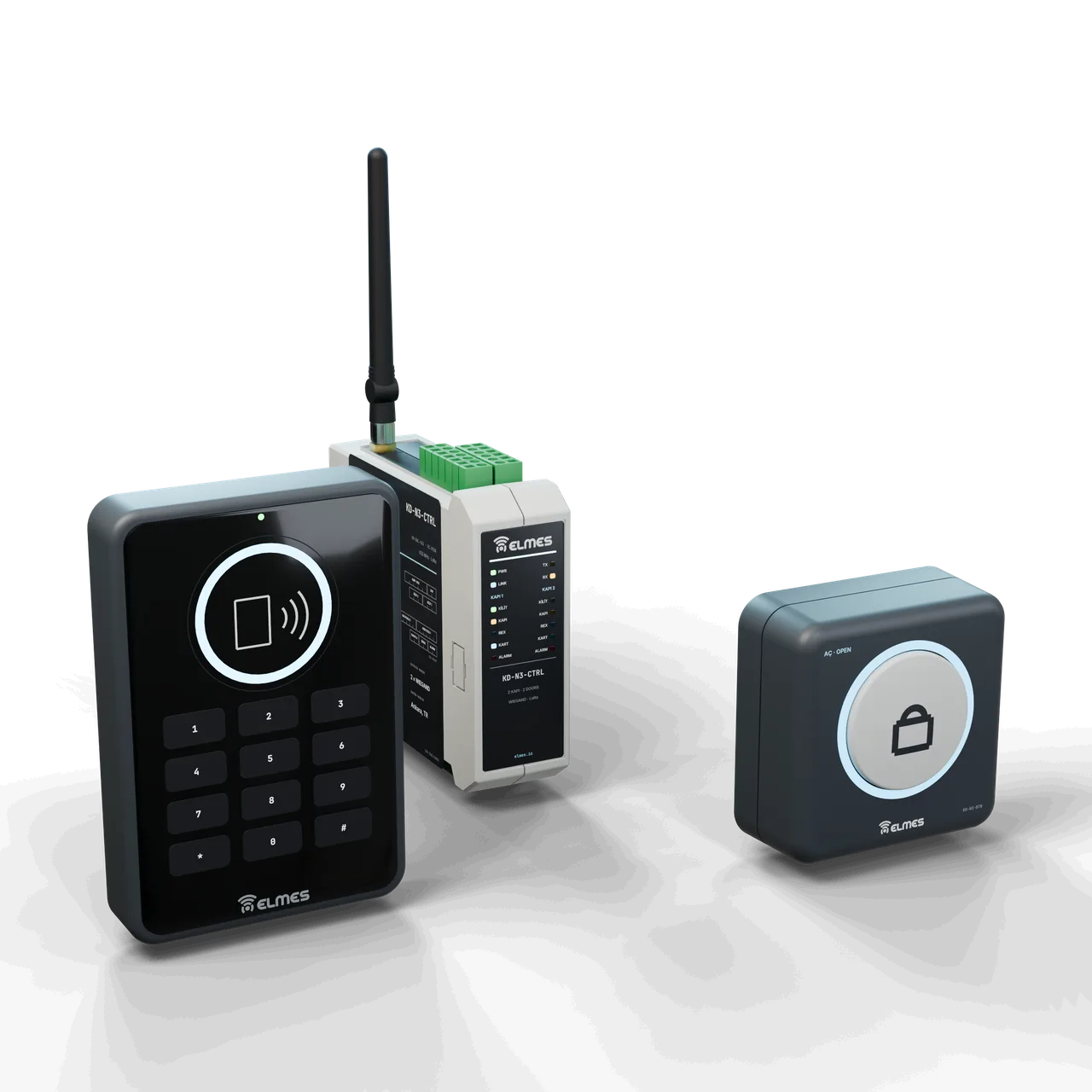
New generation. A wireless door controller at every door: lock relay, door contact, request-to-exit (REX) button and MIFARE reader are wired locally, and the controller talks to the central unit over 433 MHz LoRa. The permission table is cached at the door, so cards are still read if the central unit is offline; events (card, door held open, forced entry, remote open) are sent to the central unit and logged. The door map, manual open/close, zone- and time-based access levels and anti-passback (on doors with entry and exit readers) are managed from the touch panel or a web interface. The reader, event log and web interface are targets of the new generation.
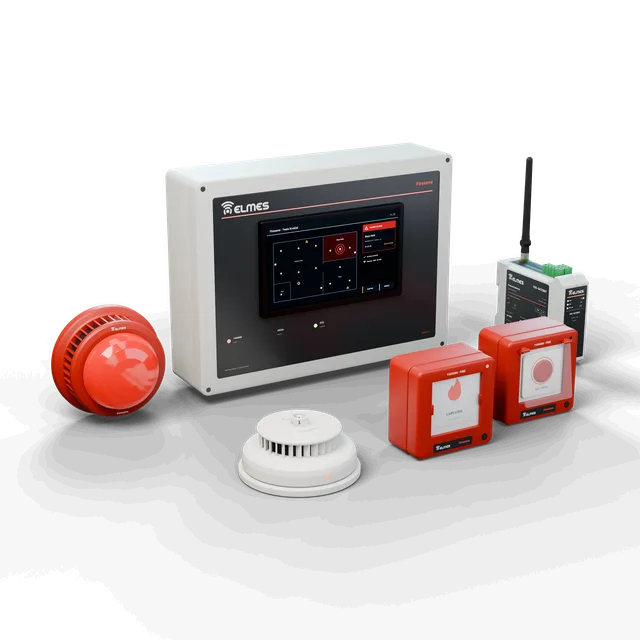
Fire integration. When integrated with the Wireless Fire Alarm System (Firesens), the assigned doors open or lock automatically on an alarm, and door status appears on the fire map.
Features
- Wireless door receiver: a relay-output receiver at the door talks to the central panel and the button transmitters over 433 MHz RF; no control cable to the door.
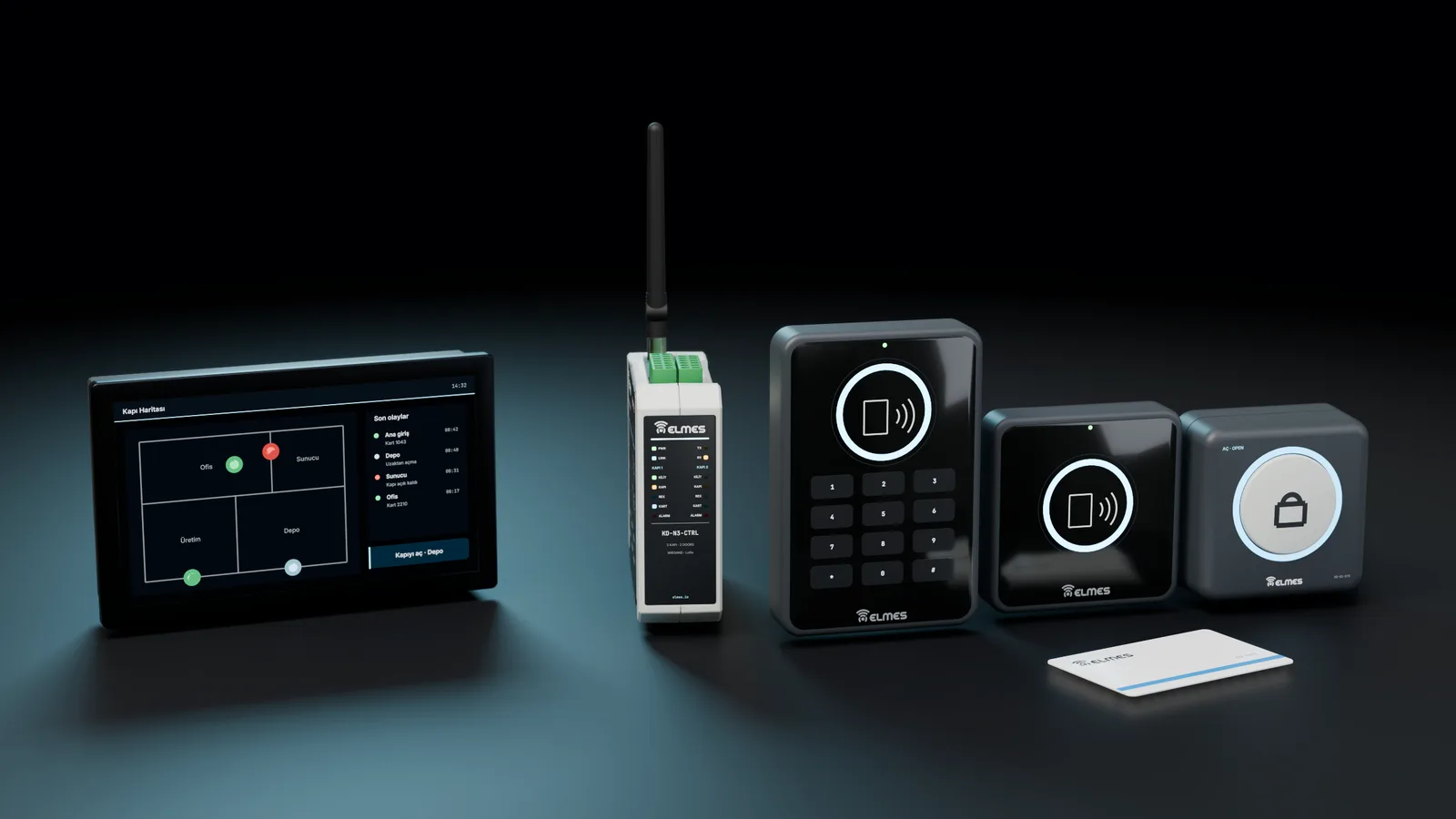
- Touch-screen door panel: door status and manual open/close at the central station.
- Remote open button: battery-powered button transmitter for the guard booth, forklifts and barriers.
- Firesens-linked door control: an assigned door profile (open / lock) on fire alarm; door status shown on the Firesens fire map.
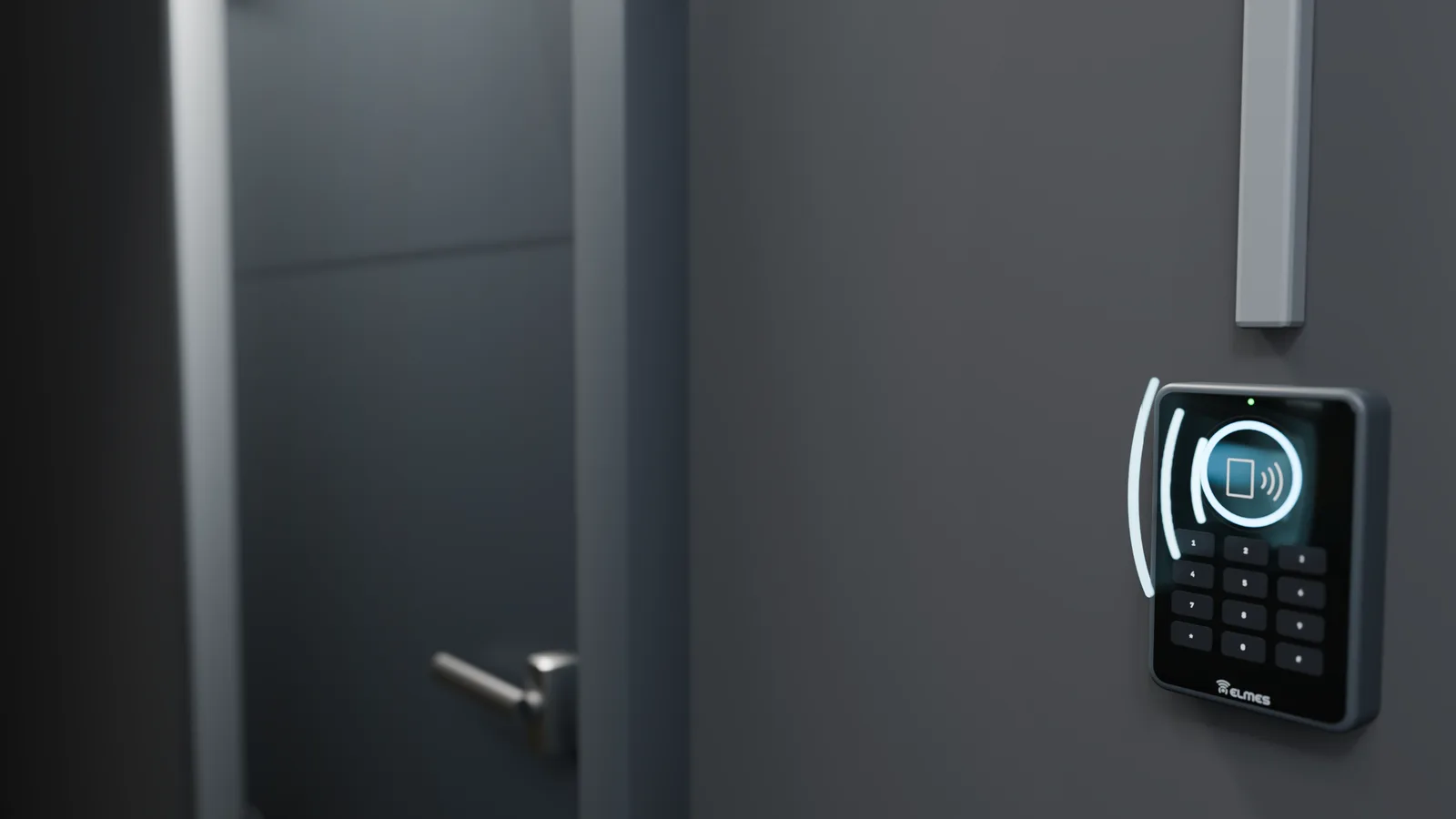
- TargetWireless door controller: lock, door contact, request-to-exit (REX) button and reader wired locally at the door; RF to the central unit, no cabling.
- TargetLocal permission cache: card access keeps working even if the central unit or the RF link is lost; events are buffered.
- TargetDoor map and web interface: door map and manual open/close on a 7-inch touch panel and via the web.
- TargetAccess management: anti-passback, access levels, time zones, visitor cards.
- TargetEvent log and reporting: who, which door, when; CSV and web reports; “door held open” and “forced entry” alarms.
- TargetRemote button with ACK LED: battery-powered remote open button and door-contact transmitter based on the Wireless Call Button Platform.
- TargetOptions: keypad (card + PIN), exit reader, turnstile/barrier interface, 125 kHz reader, WR-001 pocket notifications; BLE/mobile credentials have been trialed and are under evaluation.
System components
| Model code | Component | Hardware | Status | Request a quote |
|---|---|---|---|---|
| KD-RX (RX-KD v2.0.0) | Door receiver (relay + LCD) | PIC16F887 + CC1101 | In the field | Request a quote: KD-RX (RX-KD v2.0.0) |
| KD-TX | Door-open button transmitter | PIC16F887 + CC1101 | In the field | Request a quote: KD-TX |
| KD-PNL-TFT | Central touch panel (multi-door) | dsPIC33 + TFT + CC1101 | In the field (customer-specific) | Request a quote: KD-PNL-TFT |
| KD-N3-CTRLTarget | Door controller: 2 lock relays, door contact, request-to-exit (REX) button, reader port | EM-G0L-433 + EC-DIO8 (carrier board) | Planned | Request a quote: KD-N3-CTRL |
| KD-N3-RDRTarget | MIFARE 13.56 MHz reader (Wiegand/UART); optional keypad | RC522/SL031-class reader + EM-G0N | Planned | Request a quote: KD-N3-RDR |
| KD-N3-GWTarget | Central unit: event log, permission table, anti-passback, web/Modbus | Wireless Gateway / RTU (EM-G0LW-433) | Planned | Request a quote: KD-N3-GW |
| KD-N3-PNLTarget | Touch panel (door map, manual open) | DWIN T5L panel + EM-G0L | Planned | Request a quote: KD-N3-PNL |
| KD-N3-BTNTarget | Remote open button / door-contact transmitter (battery-powered) | CB1-W-P (Wireless Call Button Platform) | Planned | Request a quote: KD-N3-BTN |
Specifications
Values marked “Target” are design targets, next-generation values or chip-vendor data; they are updated as measurement and certification are completed.
| Frequency | 433 MHz (CC1101); channel selection via the menu |
|---|---|
| Output power | ≤ +10 dBm, adjustable via the menu |
| Receiver sensitivity | ~−104 dBm (approx.) |
| Modulation | (G)FSK |
| Packet validation | System ID + CRC |
| Separating systems on one site | By channel and ID |
| Receiver relays | 1–4 relays (based on the well/tank control board) |
| Door receiver | Box-type housing with LCD menu |
| Central panel | 4.3 / 7-inch TFT touch screen (dsPIC) |
| Antenna | Receiver/controller: SMA; panel: internal or SMA; button: internal |
| Frequency band | 433.05–434.79 MHz, 8 channels (LoRa)Target |
|---|---|
| Output power | +22 dBmTarget |
| Receiver sensitivity | −129 dBm @ SF11Target |
| Modulation | LoRa SF7–9Target |
| Open field / campus | ≥ 1000 m (SF8, external omni antenna)Target |
|---|---|
| Indoors | ≥ 150 m / 3 floorsTarget |
| RF encryption | AES-128 + counter; NetID + 16-bit addressTarget |
|---|---|
| Separating systems on one site | 8 channels × NetIDTarget |
| Card technology | MIFARE 13.56 MHz (ISO 14443A): Classic 1K/4K, DESFire EV1/EV2 UID; 125 kHz EM optionalTarget |
| Access rights | Access levels by group × door × time zone; hard/soft anti-passbackTarget |
| Event log | 100,000 events (central unit); 1,000-event buffer at the doorTarget |
| Card → lock | < 300 ms (from the local cache)Target |
|---|---|
| Remote open → lock | < 500 msTarget |
| Loss of communication | The door keeps working locally; the central unit flags it offline after 3 unanswered pollsTarget |
| Relay outputs | 2 × lock/barrier + 2 × alarm/siren (EC-DIO8: 8 relays)Target |
|---|---|
| Digital inputs | Door contact, REX, tamper, barrier photocell (EC-DIO8: 8 digital inputs)Target |
| Reader interface | Wiegand 26/34 or UARTTarget |
|---|---|
| Central interface | Panel: UART; central unit: Ethernet/Wi-Fi web interface, Modbus TCP, MQTTTarget |
| Touch panel | 7-inch DWINTarget |
| Door controller | DIN rail or IP65 boxTarget |
|---|---|
| Reader | Wall-mount 86 × 86 mm; IP65 outdoor optionTarget |
| Remote button | Battery-powered (Call Button Platform)Target |
| Operating temperature | Controller −20…+60 °C; reader −25…+60 °CTarget |
| Warranty | 2 yearsTarget |
|---|---|
| Service | Ankara; locks and readers carry their manufacturers' warranties |
Applications
- Factory entrances
- Passages between departments
- Offices and administrative buildings
- Staff entry with turnstiles
- Warehouses and cold rooms
- Archive and chemical rooms
- Vehicle barriers
- Food and packaging plants
- Public facilities
- Remote opening from the guard booth: vehicle barriers and outer doors are opened with a battery-powered button or from the central panel.
- Restricted access zones: warehouses, cold rooms, archive and chemical rooms; hygiene zones in food and packaging plants.
- Doors linked to the fire system: assigned doors open or lock on a Wireless Fire Alarm System (Firesens) alarm.
- Adding to an existing wired system: the door controller can connect to an existing panel via relays and contacts; card database integration via CSV/API is planned.
Choosing the lock. Behavior on power loss depends on the lock type: a magnetic lock releases (fail-safe, escape doors), an electric strike stays locked (fail-secure). A battery-backed supply is recommended; escape-door compliance is provided by the lock manufacturer's certification.
Compliance & documentation
Current installations are customer-specific and operate in the 433 MHz ISM band. Product-level documentation is being prepared according to the plan below.
- TargetCE – RED 2014/53/EU (EN 300 220-2, EN 301 489-1/-3)
- TargetEMC and LVD
- TargetEN 60839-11-1 — electronic access control systemsGrade to be defined
- Out of scopeEN 13637 / EN 179 — escape doors (lock side)Covered by the lock manufacturer's certification
- TargetKVKK (Turkish data protection law) — card and event data processing note
- TargetRoHS declaration
- TargetCE declaration of conformity, installation/user manual and wiring diagram (lock, contact, REX, reader)
References
Some of the organizations using this product family.
- DANONE
- ASAŞ
Frequently asked questions
Will the door still open if the link to the central unit is lost?
In the new generation, the door keeps reading cards from its local permission cache; remote opening waits until the link is back. In the current generation, the door is opened with a local button or key.
What happens to the door during a power cut?
It depends on the lock type: a magnetic lock releases (fail-safe, escape doors), an electric strike stays locked (fail-secure). A battery-backed supply is recommended.
Which cards can be used?
The new generation will work with MIFARE 13.56 MHz cards (Classic, DESFire UID); your existing staff cards are usually compatible, which we check with a sample card. 125 kHz is optional.
How many doors and cards are supported?
The new generation targets 64 doors, 10,000 cards and 100,000 events per central unit. On the current panel, doors are addressed by ID number.
How does anti-passback work?
On a door with entry and exit readers, a second pass in the same direction is denied or flagged. In the new generation, this check keeps running locally at the door even if the central unit is offline.
Can it be added to an existing wired access system?
Yes. The door controller can connect to the existing panel via relays and contacts; card database integration via CSV/API is planned.
What happens to the doors during a fire alarm?
With the Wireless Fire Alarm System (Firesens), the assigned doors open or lock automatically, and door status appears on the fire map.
Can the remote be copied?
In the new generation, AES-128 encryption with a counter prevents copying. In the current generation, packets are validated by system ID and CRC.
What about warranty and service?
A 2-year warranty is planned; service is provided in Ankara. Locks and readers are covered by their manufacturers' warranties.
Get a quote for this product
Our engineering team replies within 24 hours.
Related products
 RF & Wireless Systems
Wireless Fire Alarm System (Firesens)
Cable-free, flexible fire detection for industrial sites and sites with special requirements.
View details: Wireless Fire Alarm System (Firesens)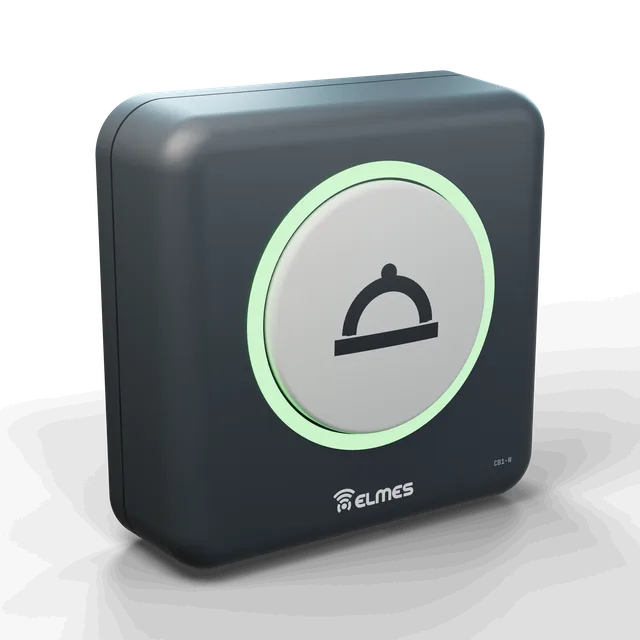 Coming soonRF & Wireless Systems
Wireless Call Button Platform
One button hardware for every call scenario.
View details: Wireless Call Button Platform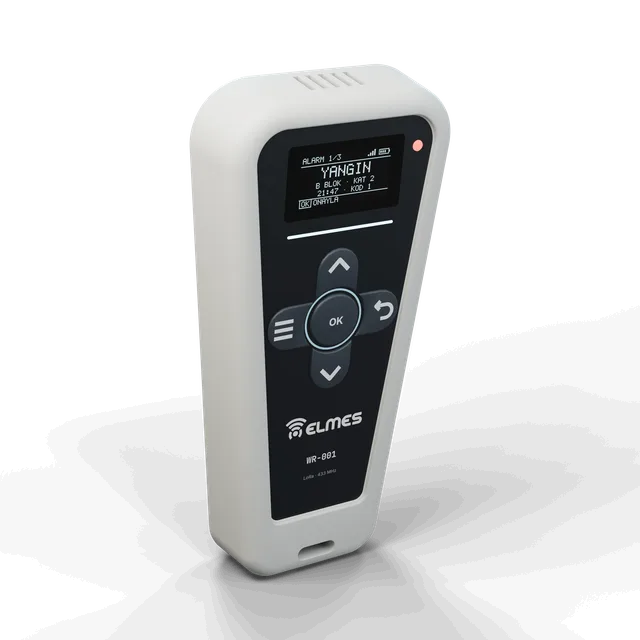 Coming soonRF & Wireless Systems
WR-001 LoRa Wireless Alarm / Call Pager
The alarm in your pocket — everyone sees who acknowledged it.
View details: WR-001 LoRa Wireless Alarm / Call Pager