Services · Service
AI Agent Development & Integration
Pipeline-based automation agents — human-approved, observable, scalable.
Overview
The problem in the field. Repetitive knowledge work (classifying support tickets, summarizing maintenance reports, procurement correspondence, data entry, generating code and documents) eats up people's time. General-purpose chatbots are not connected to company systems; what they do cannot be traced, nobody notices when they make mistakes, and the "AI pilot" never leaves the demo stage. Industrial settings add another problem: the data sits in SCADA, PLCs and devices, access and security rules are strict, and a wrong command has a physical cost.
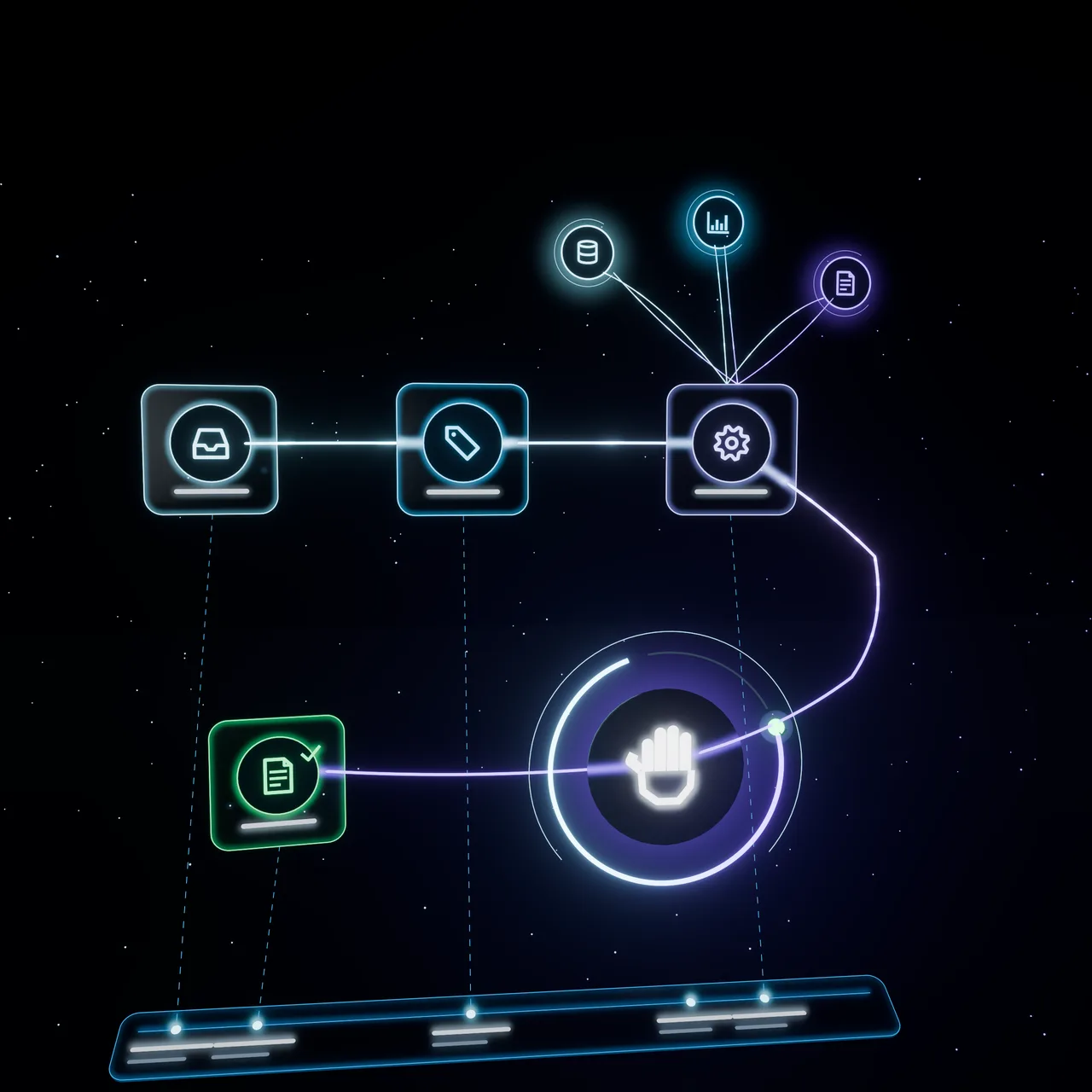
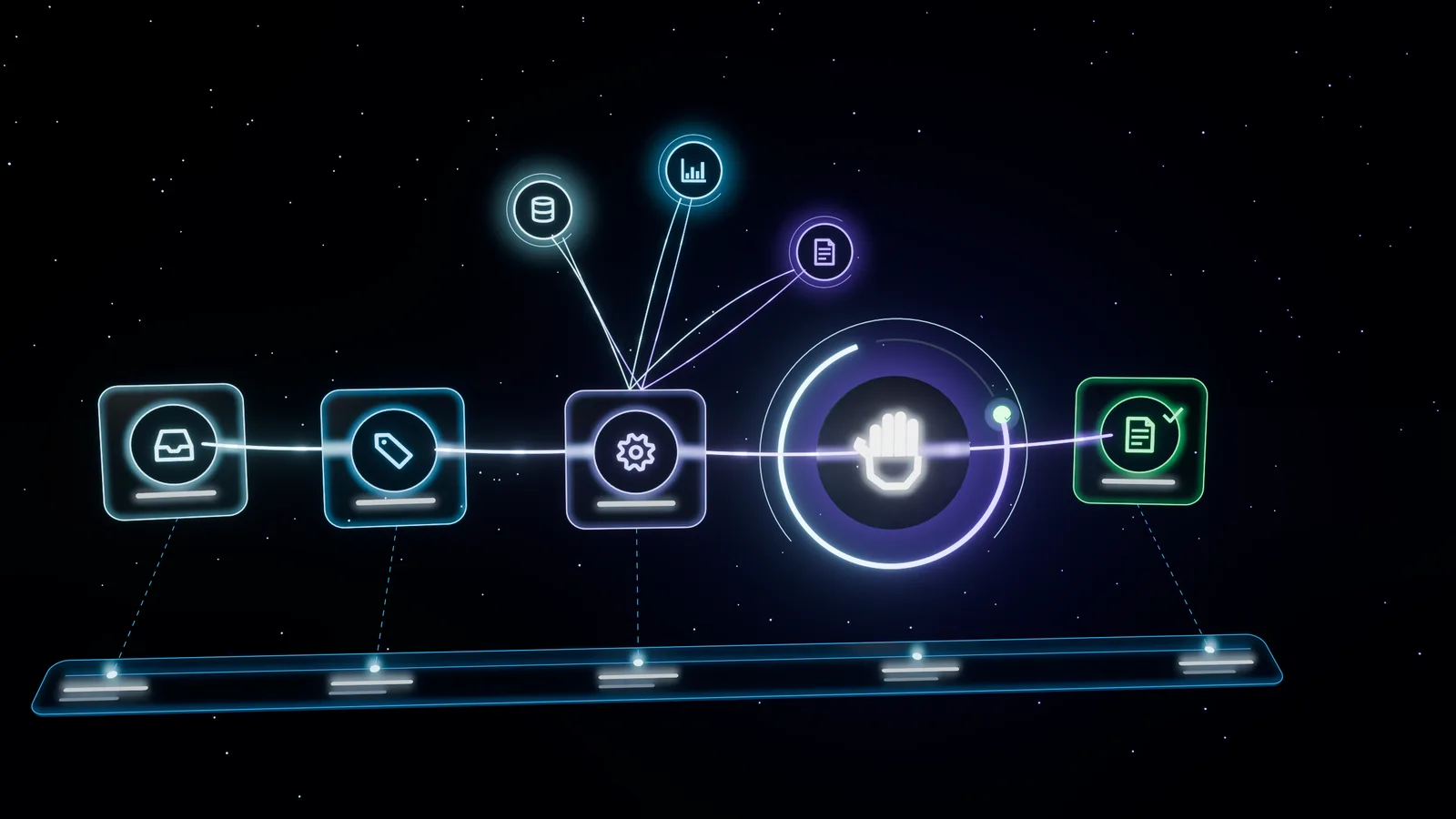
The Elmes approach. First a scenario is chosen and the metrics are defined (time, accuracy, cost). The agent is designed as a pipeline: input → classification/extraction steps → tool calls (ERP, SCADA, CRM, documents and device data, via MCP or APIs) → human approval (mandatory for risky steps) → output. Every step is traced and written to an audit log. Quality is measured with a test set and regression runs; model and prompt changes are versioned. Deployment is on the customer's premises (on-prem) or in the cloud, and the model is chosen according to data classification (cloud API / local model). Risky actions (e.g. commands to a device) are either out of scope or require dual approval.
The result. Measurable, auditable agents with a clear scope — a system in operation, not a demo. Expansion is gradual: PoC → pilot → full integration.
| Criterion | General chatbot / SaaS | Standalone agent framework (DIY) | Elmes pipeline agent |
|---|---|---|---|
| Connection to company systems | Limited / plug-ins | Developer's job | Tool integrations (ERP, SCADA, CRM, devices) |
| Traceability | None / minimal | Must be built | Trace + audit log as standard |
| Human approval | None | Must be built | HITL gates by design |
| Industrial data (Modbus, MQTT, logs) | None | Hard | Elmes's own SCADA, telemetry and gateway infrastructure |
| Quality measurement | None | Varies | Test set + regression + versioning |
| Data residency | Vendor cloud | Selectable | On-prem / cloud / local model |
This product is in development or field testing. Contact us for technical information, pilot use and a preliminary quotation.
Features
- Structured pipelines: LLM steps inside a deterministic flow; schema-validated outputs; retries and error paths.
- Tool-call integrations: MCP servers or API connectors; least privilege; separation of read and write access.
- Human-in-the-loop (HITL): approval queue, corrections and feedback; mandatory for risky actions.
- Observability: step-level traces, decision-level audit logs, cost counters; monitoring dashboard.
- AutoDev development agents: work queue, acceptance-criteria gates, code/document generation and review following the Elmes DM pattern; in internal use at Elmes and offered as a separate package for customer projects.
- Data residency options: cloud API / on-prem / local model; routing by data class.
- Quality engineering: test sets, regression, prompt/policy versioning, A/B evaluation.
- TargetAI Debate — multi-model discussion module: evaluating critical decisions from the perspective of several models.
- TargetIndustrial data connectors: Telemetry & Process Intelligence and SCADA history, Modbus/MQTT through the Wireless Gateway / RTU, device logs; alarm summarization and shift report scenarios.
- TargetKnowledge base (RAG): document search with source citations through AI Workspace.
Service scope
Indicative durations and pricing depend on project scope; final figures are set in the quotation.
Values marked “Target” are design targets, next-generation values or chip-vendor data; they are updated as measurement and certification are completed.
| Scope (included) | Scenario/metric definition, PoC, pipeline design, agent software, tool/MCP connectors (ERP, CRM, SCADA/telemetry, documents, email, device logs), HITL interface, trace/audit, test set, deployment (on-prem/cloud), training, operation and maintenance |
|---|---|
| Scope (not included) | LLM API/cloud usage fees and GPU hardware (customer account/budget); model training/fine-tuning (separate, per project); API development for the customer's own systems (coordination included); legal compliance opinions (referral provided); direct autonomous commands to physical systems (out of scope by default) |
| Process | Scenario selection and metric definition → PoC → pilot → full integration; gradual expansion |
| Typical duration Indicative | Discovery/PoC 2–3 weeks; pilot 4–8 weeks; full integration 8–16 weeks; AutoDev pipeline 4–10 weeks |
| Deliverables Target | Scenario and metrics document; PoC results report; pipeline design document; agent software and customer-specific source code; tool/MCP connectors; HITL approval interface; trace/audit dashboard; test set and regression report; deployment package and operations guide; prompt/policy files and open-source component list; training and handover documentation |
| What we need from you | A scenario owner (business unit) and an IT representative; a sample dataset (may be anonymized) and expected outputs; system API/access permissions (test environment); data classification and a residency decision (cloud/on-prem); pilot users and a feedback routine; an LLM account/budget |
| Team / tools | AI/software engineer, integration engineer (ERP/SCADA), UX designer (HITL interface); TypeScript/Node, Python, PostgreSQL, MCP, Docker; Elmes DM (work management), test/regression tooling; LLM provider APIs and a local model runtime |
| Pricing model Indicative | Discovery/PoC: fixed fee. Pilot and full integration: fixed-scope milestone payments. Operation: monthly subscription (maintenance + quality monitoring); LLM usage costs are passed through to the customer transparently |
| Warranty Target | Software defects: fixes for 6 months after delivery |
| Quality and maintenance | LLM output quality is tracked with measured metrics and a regression set; no specific accuracy is guaranteed, and the target metric is set in the contract. Regression testing and adaptation for model version changes are part of the maintenance package |
Applications
- Customer support
- Field maintenance
- Supply chain
- Software development (AutoDev)
- SCADA alarm summarization
- Shift reports
- Device log analysis
- Technical documentation
Example scenarios. In customer support: ticket classification, draft replies and a knowledge base; in field maintenance: fault-report summarization, procedure suggestions and spare-part matching; in the supply chain: order/correspondence processing and stock alerts; in software development: work queues, code/document generation and review. On the industrial side: SCADA alarm summarization and shift reports with Telemetry & Process Intelligence data, device log analysis and technical documentation.
Competence: Elmes's own products. We apply the agent approach to our own products first:
- Elmes DM: work tracking, agent memory, acceptance-criteria gates and MCP for software work run by LLM agents (prototype).
- AutoPCB: a multi-step AI pipeline that produces schematics, autorouting, DRC/ERC and Gerber files from natural-language requirements (MVP; test suite green).
- DiscOS: an AI-first shell on an embedded device (58 commands).
- AI Workspace: an assistant-profile and knowledge-graph platform (closed early access).
- Internal MCP-based agent experiments.
These are Elmes's own products and internal use cases; they are not presented as customer references. No customer case study has been published yet.
Compliance & documentation
Contract and intellectual property
- Contract: SOW and milestones; a subscription/SLA annex for operation. The LLM provider contract is made in the customer's name or passed through transparently via Elmes.
- Intellectual property (proposed default): the customer-specific pipeline, prompt/policy files and connectors belong to the customer; Elmes framework components (Elmes DM, the pipeline runtime, generic MCP servers) remain with Elmes and are provided under a usage license. An open-source component list accompanies every delivery.
- Confidentiality: customer data and process information are covered by an NDA; deletion or return of sample datasets at the end of the project is written into the contract.
- Self-declaredKVKK / GDPR data-flow assessmentFor scenarios involving personal data: data inventory, purpose limitation, a data processor agreement with the LLM provider and a cross-border transfer assessment; anonymization or a local model where needed
- TargetEU AI Act risk class and technical documentationThe scenario's risk class is determined; model card, data source and human oversight documentation are provided. Elmes does not give legal opinions
- Self-declaredSecurity principles: least privilege, tool allow-list, prompt injection countermeasures, audit log retentionModel providers' usage policies and data retention terms are assessed during selection
- Self-declaredIEC 62443 principles — industrial connectionsIndependent interlock on the PLC/SCADA side for physical system commands
- TargetProject document templates (scenario/metrics, risk class checklist, SOW, data processing annex, model card)
- Out of scopeLegal compliance opinionReferral to your legal team and technical documentation support are provided
Frequently asked questions
What does an agent do, and how is it different from a chatbot?
A chatbot answers questions; an agent performs a defined task (classification, summarization, data entry, drafting) step by step by connecting to your systems, asks for human approval where needed and records every step.
Which systems can it connect to?
ERP, CRM, document repositories, email, SCADA/telemetry and device logs, via APIs or MCP servers. For systems without an API, a connector is written or the system is left out of scope.
Will our data go to a cloud model?
It depends on the data class: cloud API, on-prem deployment or a local model. Personal data and trade secrets are protected with anonymization and contractual safeguards.
What if the agent makes a wrong decision?
Risky steps require human approval; outputs pass schema validation and every decision is written to the audit log. Accuracy targets are measured; 100 % accuracy is never promised.
Can it send commands to machines or SCADA?
Not by default; the agent reads and recommends. If included in scope, it is done with dual approval and an independent interlock on the PLC/SCADA side.
How long does it take and what does it cost?
As an indication, a PoC takes 2–3 weeks and a pilot 4–8 weeks; quotations are fixed-scope. LLM usage fees are separate and passed through transparently.
Do you have references?
No customer case study has been published yet. Elmes's own tools (Elmes DM, AutoPCB) are the in-house proof of the agent approach.
Will the system break when the model changes?
Every change is measured against the regression set; model and library migrations are covered by the maintenance package.
Can our own team maintain the system?
Yes. The pipeline, prompt/policy files and connectors are delivered with documentation, and training is provided.
Let's talk about your project
Our engineering team replies within 24 hours.
Related products
 Coming soonAutomation & Telemetry
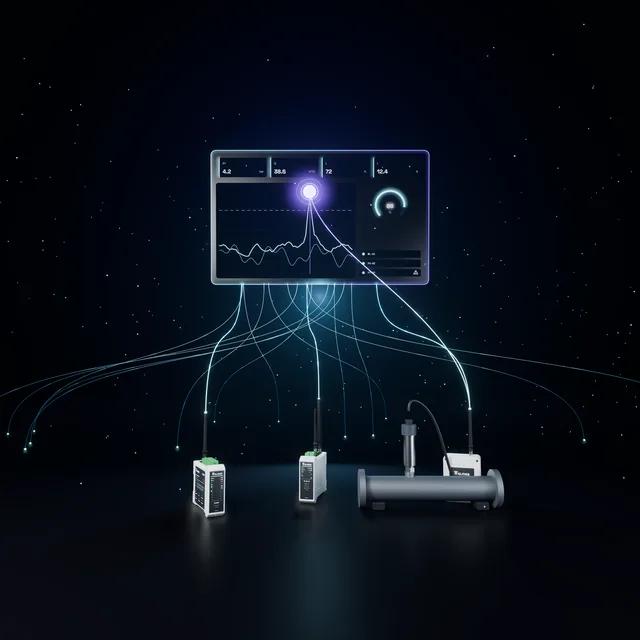
Telemetry & Process Intelligence
Field data into semantic memory, semantic memory into decisions.
Early access / pilot
View details: Telemetry & Process Intelligence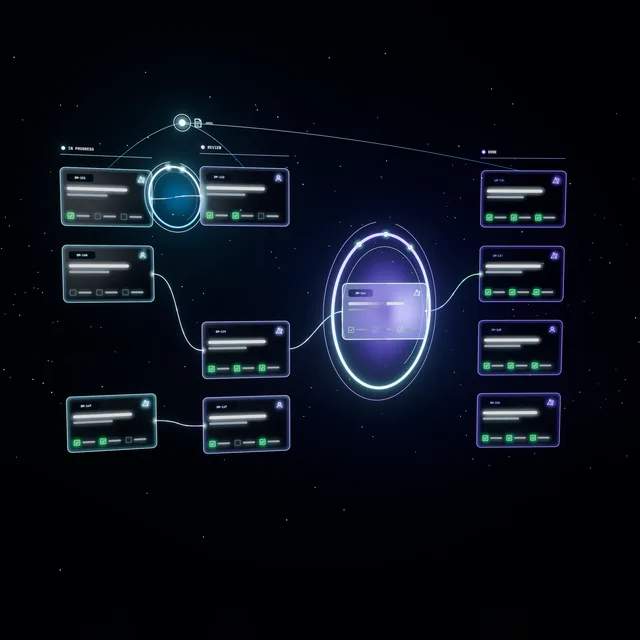 Coming soonAI & Software
Elmes DM
Manage your agents' work, memory and acceptance gates in one place — records, not files.
View details: Elmes DM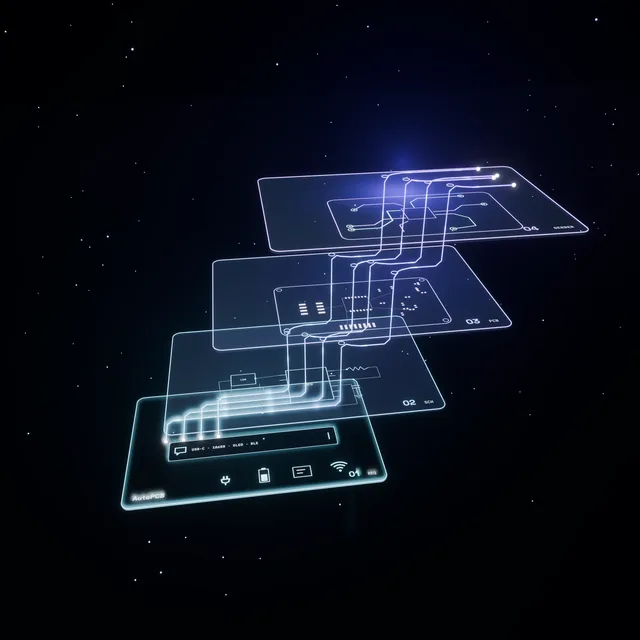 Coming soonAI & Software
AutoPCB
From natural-language requirements to a Gerber package: schematic, placement, autorouting and DRC in one browser.
View details: AutoPCB